Suffering is inevitable — whether you are a disciple of Jesus or not. Jesus teaches us that in this world we will have trouble, then reminds us he has overcome the world (John 16:33). His half-brother James goes further: not if you face trials, but when (James 1:2).
The reality, though, is that we are not Jesus. He is the head. He is the only Teacher. He is the One who lived through hell on earth without sinning through the suffering.
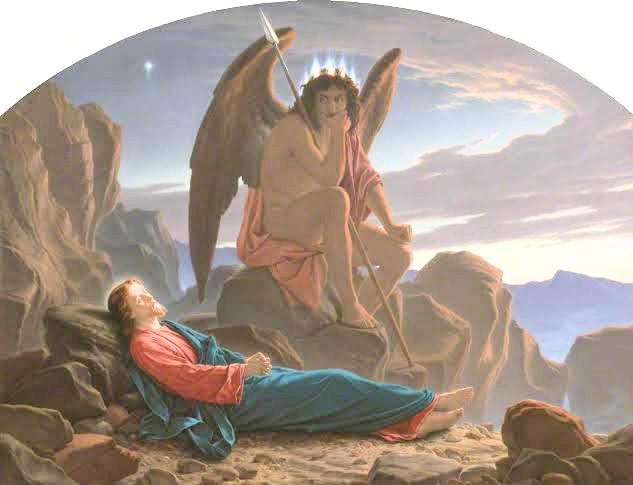
The painting Satan Watching the Sleeping Christ by Sir Joseph Noel Paton presents the father of lies in an interesting, sobering manner. No horns. No pitchfork. He doesn’t appear particularly violent to the casual observer, yet behind the eyes smolders a dark fury. The brow ever so slightly furrowed. His left hand clenches as he studies Jesus. Watching, waiting, knowing he is weak, hungry, and tired.
Satan’s modus operandi is the same today. He prowls around looking for someone to devour (1 Peter 5:8). When Jesus awakens, Satan doesn’t pounce. He offers food — not for nourishment, but to get Jesus to depend on something other than the Word of God (Luke 4:4).
Jesus responds, not with a sermon, not with a speech about how holy he is, but with the Word of God.
Result? Jesus did not sin. He did not sin in the suffering. He did not sin in the trial. Unlike us, Jesus is perfect. He is the Word made flesh, and his Spirit in us is what keeps us from falling — so that we display the fruits of the Spirit (love, joy, peace), not the works of the flesh (hate, anger, jealousy).
Consider Cain and Abel. God warns Cain that sin is crouching at his door, and he must rule over it. Notice God doesn’t shoo the sin away from Cain. Instead, he tells Cain to take charge of his own free will.
And so must I. So must we all.
My prayers are often filled with pleas for God to shoo away the trouble. Please change this, please change that, please change this one, please change that one. But no.
Why do I expect God to do all the heavy lifting? Who am I to expect him to send away every trial meant to make me better? Am I to refuse training?
Paul writes otherwise: “But we glory in tribulations also, knowing that tribulation works patience, and patience, experience, and experience, hope” (Romans 5:3-4).
He gave me free will to exercise. He gave me gifts of discernment. He gave me a clear mind to think and a strong will to act independently of the opinions around me.
So where is my part? What is my responsibility here? Am I to keep pleading with God to change my circumstances like a child?
No. I can ask. But I must trust the answer.
In the garden, Jesus did ask for the cup to be removed. Three times the Son of God asked, and three times the request was denied (Matthew 26:39-46). The asking was never the point. It’s how Jesus responded after the denials — he remained obedient, denied the flesh, and endured it all to the end without sinning.
So today my prayer isn’t for God to remove the pain, the fatigue, the fear, the disappointment that makes me want to snap at the person I love most. My prayer is for the grace to pick up my cross and follow Jesus instead. Deny yourself — that doesn’t sound like change. Pick up your cross — that doesn’t sound like change either. And follow me, not your comfort (Luke 9:23).
The Spirit inside of us protects us from the enemy by calling us to dwell in him. Through complete surrender — sweet surrender — we let him respond for us, keep us quiet, and destroy every weapon formed against us by the enemy of our souls.
But surrender isn’t the loss of my free will. It’s the use of it. God’s Spirit acts where he is invited — and every time I choose to invite him instead of grabbing the wheel back myself, that’s my will, exercised, not surrendered away. My part is simply to keep inviting him, especially when everything in me wants to take control.
The enemy of your soul knows his days are numbered, and he wants to take as many people with him as he can. You don’t have to be one of them. Surrender the wheel. Let the Spirit lead you out of the same darkness he already called you out of — into his marvelous light (1 Peter 2:9).
Leave a Reply